How Yellow Card scales compliance across five continents with Archer

Yellow Card's compliance team uses Archer to monitor transactions, screen customers against sanctions and politically exposed person (PEP) lists, and review suspicious activity across its business flows.
About Yellow Card
Yellow Card is a global stablecoin infrastructure provider, supporting over 50 currencies, with over $10B facilitated. The company went fully B2B in late 2025.
In November 2026, Yellow Card acquired GoMoney, a virtual asset service provider in São Paulo, giving it direct operations in Brazil, Latin America’s largest crypto market. Since mid-2025, it has added admission to a sandbox in Ghana, an approval in principle in Nigeria, and licenses or approvals in Zambia, Switzerland, and Canada, sponsorship from two of South Africa’s largest banks, and partnerships with Visa, Mastercard, and Fireblocks. It has also raised a $40 million round with Standard Chartered’s SC Ventures.
Every one of those relationships starts with the same question: can you demonstrate how effective your compliance programme is?
Growing Yellow Card across continents means securing new licenses and winning new partners. Regulators and partners want to see how we monitor transactions, make decisions, and document them. Archer provides the compliance infrastructure behind that growth.
Chris Maurice, CEO and Co-founder, Yellow Card
Monitoring business flows
Going B2B changed what Yellow Card had to monitor. Its previous fraud tool wasn’t built for a company operating across so many markets and business flows. The risk now sits in business flows, and each flow brings its own: businesses connecting through Yellow Card’s API, payment partners settling with it, large trades on its OTC desk, and the end users of the apps built on its rails.
We monitor all of these flows in one place, and Yellow Card has moved its fiat transaction screening to Archer.
What stood out about working with Archer was their understanding of a regulated fintech operating in emerging markets. They treated our compliance requirements as a priority, not an afterthought, and that made the rollout smooth, fast, and collaborative.
Chanal Subramoney, Group Senior Compliance Manager (Group MLRO), Yellow Card
One compliance team, many countries
From April to October 2026, we monitored Yellow Card’s transactions across five continents.
Yellow Card covers all of them with one compliance team, from Archer. A rule can run in every market at once, or be aimed at a single country when a regulator or a market needs it.
Every license Yellow Card adds brings new monitoring requirements. If we had built this in-house, each one would have taken my engineers away from our product. With Archer, our compliance team writes the new rules itself, and my engineers keep building Yellow Card.
Justin Poiroux, Co-Founder and CTO, Yellow Card
Screening and case review
We check the people on Yellow Card’s platform against sanctions and PEP lists: 1.1 million checks so far. Possible PEP matches go to a queue for Yellow Card’s financial intelligence team, which escalates the ones that need it to the money laundering reporting officer (MLRO).
Alerts from Yellow Card’s transaction-monitoring rules go to its analysts, who work their own queue in shifts. Each case they close records their decision: approve or decline. They have reviewed and decided more than 3,200 cases in Archer.
The compliance team runs its own rules
Watching Yellow Card’s flows only helps if the alerts are worth an analyst’s time. Our team set up the first rules with Yellow Card. Since then, its compliance team has switched on every live rule and tunes them straight from the dashboard, without waiting on engineers.
When fraudsters change their pattern, we change the rule and it takes effect immediately. My team does it ourselves, without opening a ticket with anyone. That keeps us ahead of financial crime threats.
Japhet Gana, Group Head, Transaction Risk & Financial Crime, Yellow Card
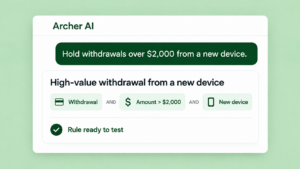
Nearly every rule the team has written started with Archer’s AI assistant. Someone on the team describes the rule in plain words, the assistant drafts it, and the team reviews it and can test it against past transactions before switching it on.


Across all rules, alerts fell 93% between June and September. The biggest single change came in June, when Yellow Card’s transaction-risk team retuned the noisiest rule with the AI assistant. That rule’s alerts started falling that day, and within two days it went from thousands of alerts a day to fewer than 15.
Case review and reporting with AI
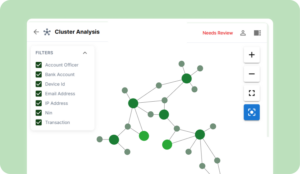
The assistant has also become part of how Yellow Card’s analysts review cases. While working a case, an analyst can ask it to summarise what happened, pull up the transactions and earlier alerts of the person or business in the case, check the accounts linked to them, and draft the case note.

The assistant also builds the team’s reports. A team lead describes what they need, like the week’s cases and how each was decided, and the assistant builds the report from Yellow Card’s data.
Who changed what, and when
Archer logs rule changes and case decisions with who made them and when, including the rule changes made with the AI assistant, which are logged under the person who applied them. Earlier versions of each rule are kept, so when a regulator asks why a rule looks the way it does, the team can show how it got there and who changed it.
Everything I oversee is about protecting our licenses and keeping the trust of our partners: the banks, mobile money operators, and payment providers that give us access to fiat rails. Without them, we can't operate. Archer helps us meet our AML requirements at a global scale.
Chanal Subramoney, Group Senior Compliance Manager (Group MLRO), Yellow Card
Questions about Yellow Card and Archer
What does Yellow Card use Archer for?
Yellow Card uses Archer to monitor transactions across its business flows, to check people against sanctions and PEP lists, and to review and decide cases, with a log of who changed what and when. It has also moved its fiat transaction screening to Archer.
When Yellow Card’s compliance team needs something new, it sets it up in Archer itself or asks Archer’s team. Yellow Card’s engineers stay focused on building its product.
How does Yellow Card’s team use AI in Archer?
Yellow Card’s team uses Archer’s AI assistant to draft new rules from a plain-language description, to tune existing rules, and to look into cases: summarising them, pulling up transactions and alerts, and checking linked accounts. Team leads also ask it for the team’s reports, like the week’s cases and how each was decided.
Can Yellow Card’s compliance team change rules without engineers?
Yes. Yellow Card’s compliance team writes, tests and switches on rules itself from the dashboard, without waiting on engineers. Archer’s team set up the first rules with it.
Expanding into new markets or onboarding new partners? Talk to us →