Switching from an AI-powered alternative to Archer’s platform for transaction monitoring, case management, and multi-market operations

Background
Yellow Card operates across multiple regulated markets, supporting cross-border stablecoin flows through licensed banking partners. Their compliance operation handles real-time monitoring, case management, and regulatory reporting across the customer lifecycle. Onboarding data from AiPrise, blockchain analytics from Chainalysis and other providers, customer service workflows, and core payments data all flow into Archer.
That operation ran on Sift for years, originally drawn in by the same pitch driving most fintechs to AI-powered alternatives today: configurable rules, AI enhancements, dramatic false-positive reduction. Sift didn’t break for Yellow Card because the pitch was wrong. It broke because the platform couldn’t keep up as operations scaled across markets, products, and rails, and the alternatives carry the same limits.
What this covers
- Consolidation: investigation as a single workflow
- Full control without engineering or tech resources
- AI rule engine and recommended rules
- Most rule engines were built for one market, 1-2 products, and maybe a couple of rails
- Built for emerging markets and developed markets at the same time
- Multi-regulator reporting and per-market operating requirements
1. Consolidation: investigation as a single workflow
Yellow Card’s investigators worked across four-plus tools per alert. The rule engine flagged the alert, investigators discussed it in chat, the internal dashboard held the customer view, partner dashboards held the analytics, and the support tool held the customer correspondence. Cases didn’t tell a coherent story, and the audit trail had to be stitched together manually. As volume grew, time-per-alert grew with it, and regulators reviewing decisions had to follow trails across separate systems to make sense of any individual case.
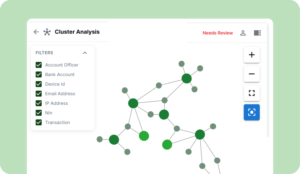
Archer brings crypto analytics (Chainalysis, Elliptic, TRM), KYC (AiPrise), customer service workflows, RFIs, alerts, audit, and reporting into one platform. The investigation timeline is the case narrative, structured for the analyst, the regulator, and internal review at the same time. Four-plus tools collapsed into one.
2. Full control without engineering or tech resources
With Sift, compliance filed engineering tickets for nearly every dimension of the work. Modern AI-powered alternatives advertise no-code rule builders that promise rule configuration in minutes, but the trap is that this only addresses rules. Pulling backend data for an investigation, calculating analytics across alerts, and surfacing the right context for a case all still required engineering. The self-serve framing didn’t extend past the rule UI, which made tech team bottlenecks unavoidable. The platform’s idea of self-serve was narrower than the work.
Archer puts rules, data, and analytics directly under compliance. When a capability is missing, Archer ships fast: targeted updates within days, larger features within weeks, against an industry standard measured in quarters. We built the platform expecting every customer to have a different data shape, team shape, and operating shape, and most platforms aren’t built with that in mind. Rule changes go live same-day instead of waiting on sprint cycles.
“My team used to spend a meaningful chunk of every sprint on compliance tickets, rule changes, backend data pulls, analytics work. Since we moved to Archer, that work effectively went to zero. Compliance handles it directly in the platform.”
Justin Poiroux, CTO, Yellow Card
3. AI rule engine and recommended rules
Sift handled typical risk scenarios well: velocity rules, device connections, geolocation logic, amount thresholds. Where it broke was the largest fraud surface for a stablecoin operator, which is stolen funds entering the ecosystem (compromised cards, fraudulent bank transfers, mule-network funding, identity-theft-opened accounts). Detecting that surface meant combining signals: a recently-funded account suddenly moving into stablecoin, repeated velocity from a single funding source, a mismatch between funder location and account holder, or a chained receive flow across corridors. The rule engine couldn’t express those combinations. So the head of compliance briefed an engineer, who briefed Sift’s PM, who configured something close to what compliance had asked for, often not quite right. Modern alternatives ship better rule UIs, but the back-and-forth between compliance, engineering, and the vendor still happens once rules get complex.
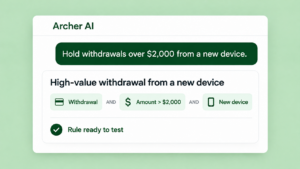
In Archer, plain-language rule authoring lets compliance describe a scenario in their own words and get a runnable rule. Recommended rules surface patterns the system has detected and propose configurations from the actual transaction data. Both are backtested automatically against historical data and can run in shadow mode against live traffic before going active. Detection of real malicious activity increased 2.5x.
4. Most rule engines were built for one market, 1-2 products, and maybe a couple of rails
Most rule engines were built for fintechs operating in one market, with 1-2 products, on maybe a couple of rails. Yellow Card runs across markets, products, payment channels, currencies, customer segments, and counterparty geographies, with rules that need to vary across all of them. Vendors support the data points individually, but the configuration breaks down once you start combining them. Global fintechs hit that wall; single-market fintechs don’t. The rule engine gave out before the team did.
Archer’s rule logic handles the combinations natively, including currency conversion in thresholds, per-segment risk profiles, and counterparty-geography branching. False-positive alerts dropped 70% overall, with some customer segments seeing over 90% reduction.
“As we added markets and products, Sift’s rule engine kept hitting limits. We ended up writing custom logic in our own dashboard to handle the cases their engine couldn’t express. That wasn’t a sustainable place to be.”
Justin Poiroux, CTO, Yellow Card
5. Built for emerging markets and developed markets at the same time
Sift and AI-powered alternatives are calibrated to a global average that’s heavily Western. Screening, fuzzy name matching, and risk typologies over-flag legitimate users in francophone, anglophone, and Arabic-script African markets while missing corridor-specific patterns. The vendors’ biggest customers operate in single developed markets, so emerging-market patterns aren’t part of how the systems were built. African-market customers got friction at scale, African-market fraud went undetected, and compliance lost hours per day clearing false positives that weren’t real risk, getting in the way of filing reports in line with SLA. At the same time, Yellow Card works with regulated banking partners outside Africa, which carries the same expectations developed-market regulators and partners apply to any platform handling those flows.
Archer handles African market specifics natively. Name matching, screening logic, and risk typologies work across francophone, anglophone, and Arabic-script users without retuning. The same platform meets the standard developed-market regulators and banking partners expect.
6. Multi-regulator reporting and per-market operating requirements
Yellow Card files in multiple regulator regimes via licensed banking partners. Each regulator has its own STR/CTR format, SLA, and operating requirements: some are formulaic and API-driven, others require narrative context. Other platforms assumed a single jurisdiction, so their reporting engines didn’t bend to per-regulator variation. Compliance ended up manually formatting outputs for each regulator, which put filing SLAs at risk and created audit exposure.
Archer ships per-regulator filing templates, configurable SLAs, and support for both formulaic API-driven reports and contextual STRs. For narrative-heavy filings, Archer uses LLMs to generate STR narratives grounded in local-regulator context, drafting from the case timeline rather than blank-slate. Adding a new regulator means configuring, not rebuilding.
Results
- False-positive alerts: 70% reduction overall, with some customer segments seeing over 90% reduction.
- Investigation time per alert: From ~15 minutes to ~5 minutes (67% reduction).
- Rule changes: Same-day, versus sprint cycles previously.
- Tools used per investigation: 4+ collapsed into 1.
- Engineering tickets from compliance: From dozens per sprint to effectively zero.
- Detection of real malicious activity: 2.5x increase.
- Filing SLA across regulator regimes: On-time, regardless of regulator timing.
Bottom line
After moving to Archer, compliance moves without tech team bottlenecks. Rules, data, analytics, and reporting all live in one platform, the rule engine handles the operating shape Yellow Card actually has, and screening and risk typologies work across the markets Yellow Card actually serves. Reporting scales as new regulators come on.