Your best analyst already knows where the losses are coming from. They have spent months inside your transactions, and they can tell you precisely what a bad one looks like on your platform, in a level of detail no generic model would arrive at.
The bottleneck has never been that insight. It is the distance between an analyst noticing a pattern on Tuesday and a rule catching it in production.
At most fintechs that distance is measured in weeks. At Archer it is measured in seconds.
Two Ways to Build a Rule, and Both of Them Are Slow
Until now you had two options.
Send it to your engineers. The pattern becomes a ticket, the ticket joins a roadmap, and it competes with the product work your company is actually judged on. Increasingly the shortcut is to paste the description into an LLM and get a rule back in a minute. That rule is generically reasonable and knows nothing about your schema, your customer base, or the specific way you are being hit this month. It is a plausible rule, not your rule.
Use the rule engine you already have. Every platform in this category makes the same promise. No dependency on tech teams. No-code interface. Built specifically for compliance professionals, with zero manual programming. New scenarios deployed in minutes, not months.
Then you try to build something genuinely specific, and the compliance lead is back in a meeting with a product manager or an engineer to get it over the line. The no-code promise holds for the rules that were easy anyway.
Slow Rules Cost You Twice
While the rule sits in a queue, the fraud it would have caught keeps happening.
When you cannot build a precise rule quickly, you build a blunt one instead. Block every transfer over $5,000. It does stop some fraud, and it also stops every legitimate customer who wanted to send $6,000 to their family.
A blunt threshold also does not stay secret. Binance let unverified accounts withdraw up to two bitcoin a day, and FinCEN’s 2023 consent order describes what followed: a mixing service opened multiple accounts and pushed thousands of transactions of between 1.9 and 2 bitcoin each through them, moving over $40 million by sitting just under the line.
Rules also need to fit the product they monitor. TD Bank used wire-transfer monitoring scenarios for Zelle payments. FinCEN found that their high-dollar thresholds were poorly suited to Zelle’s smaller transactions, leaving suspicious activity undetected. The bank had monitoring in place, but it was looking for the wrong patterns.
Every fintech launching a new product or entering a new market is one release away from the same problem.
Archer’s Rule Engine Builds Any Rule in Seconds
You describe the pattern in plain English. An agent turns it into a working rule, tests it against your own historical transactions, and shows you what it would have caught before anything goes live.
Be as specific and as strange as your fraud actually is. The rules that are hardest to express elsewhere are usually the ones worth the most, because they are the ones nobody else’s model has seen.
Change them as often as you want. There is no limit on rules and no limit on revisions, because the cost of a revision is no longer an engineer’s afternoon.
Here is what that looks like end to end.
Describe the pattern the way you’d say it out loud
Start with a simple pattern: a high-value withdrawal from a device the customer has not used before. So that is what you type:
“Hold withdrawals over $2,000 when the customer is using a new device.”
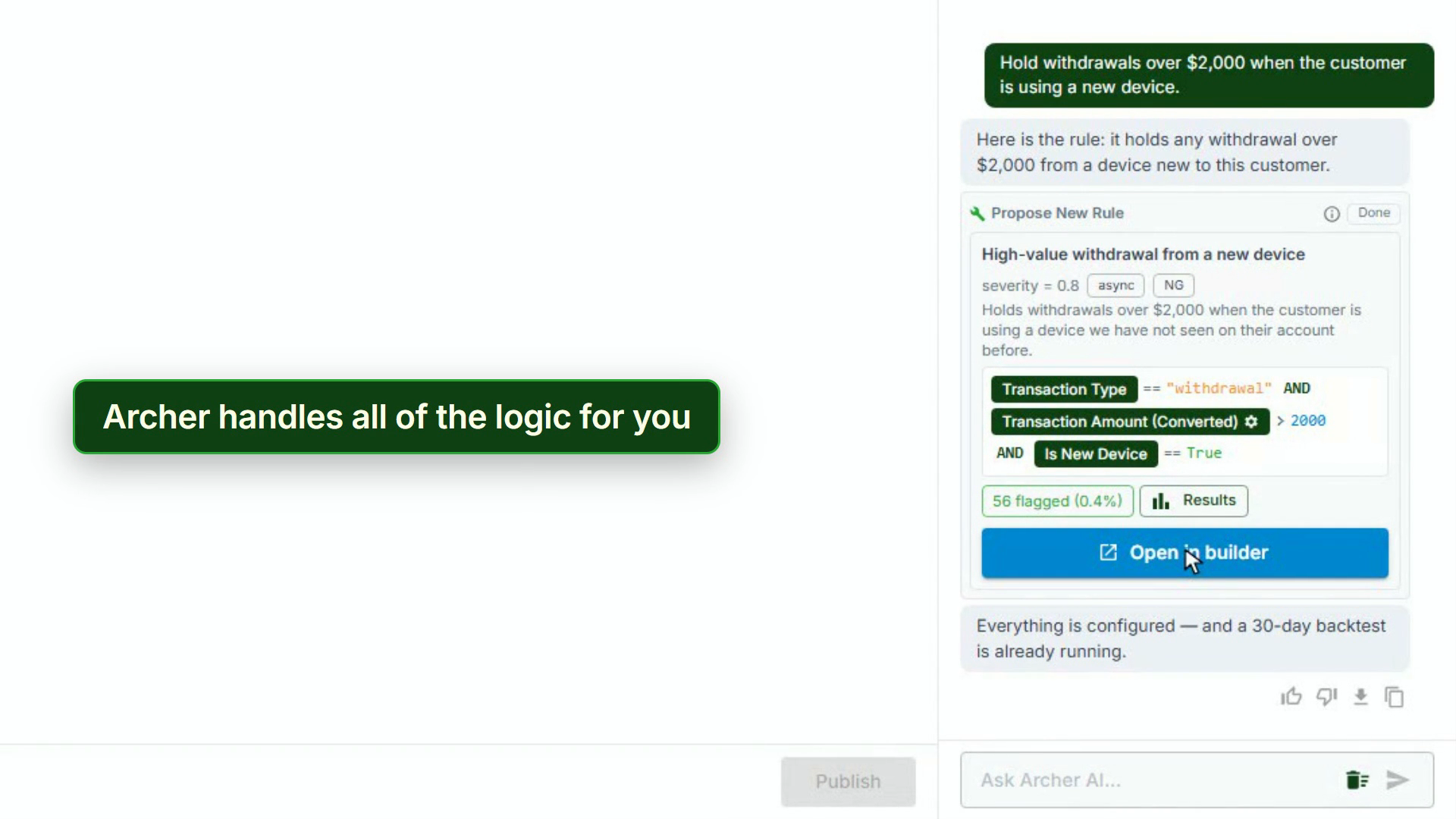
No field names, no operators, no query language. Describe the pattern in the AI chat; Archer works out the fields and conditions for you. The builder shows the logic Archer has generated—you do not need to learn that syntax or assemble those conditions yourself.
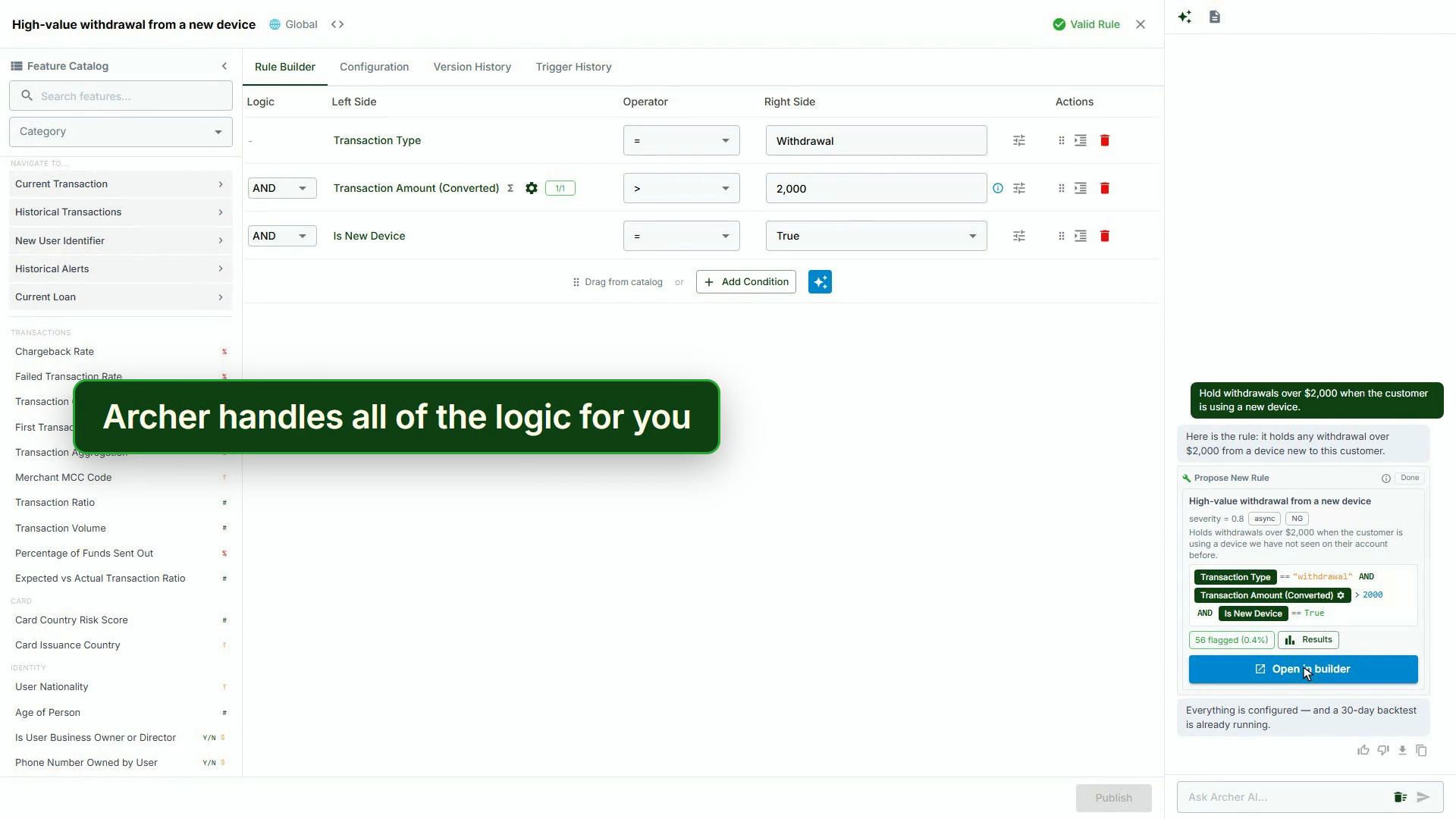
Keep adding conditions until it matches the real pattern
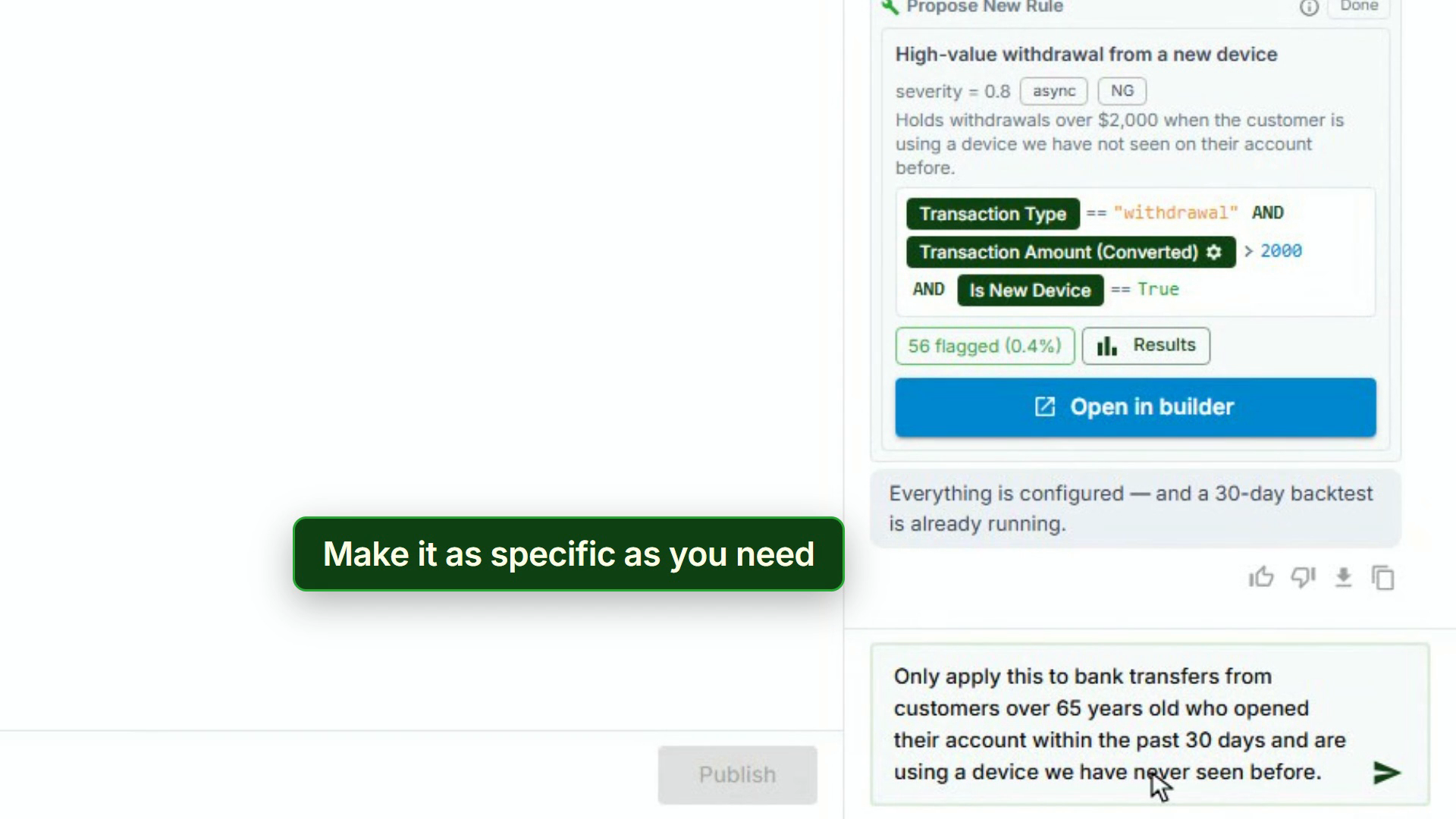
The actual pattern can be narrower. Keep refining until the conditions match what your team is seeing:
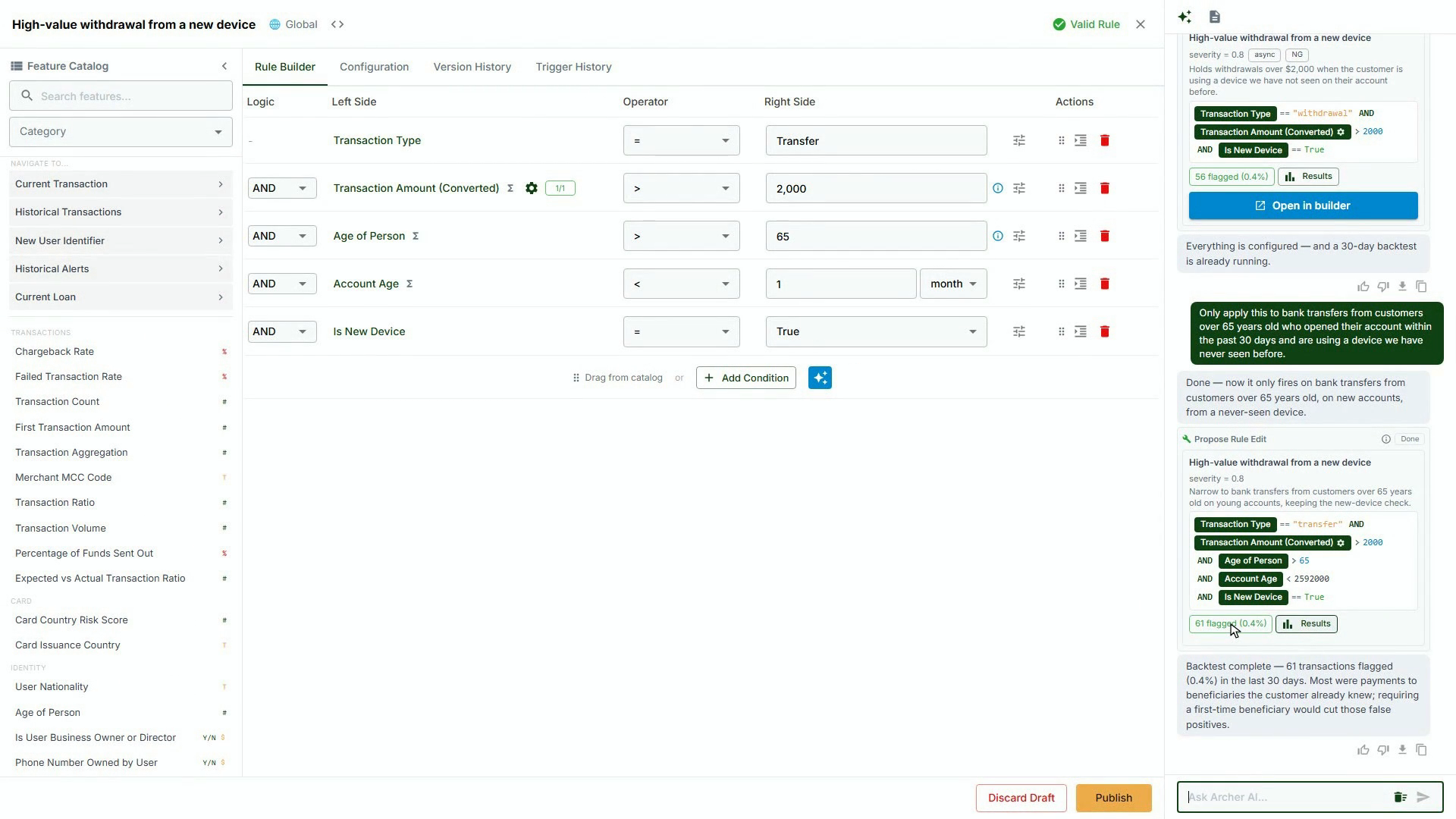
“Only apply this to bank transfers from customers over 65 years old who opened their account within the past 30 days and are using a device we have never seen before.”
This is the step that usually stops people. Each extra condition is another field to join, another edge case, another round trip with whoever owns the data model. Here it is another sentence.
See what it would have caught, before it goes live
Archer tests the rule against your historical transactions before it goes live. In this demo, the backtest flags 61 transactions—0.4% of the transactions in the last 30 days.
The accompanying summary points out that most were payments to beneficiaries the customer already knew, and suggests requiring a first-time beneficiary. That gives the analyst a concrete next refinement to test.
Change your mind as many times as you need to
The backtest suggests tightening the beneficiary condition. So:
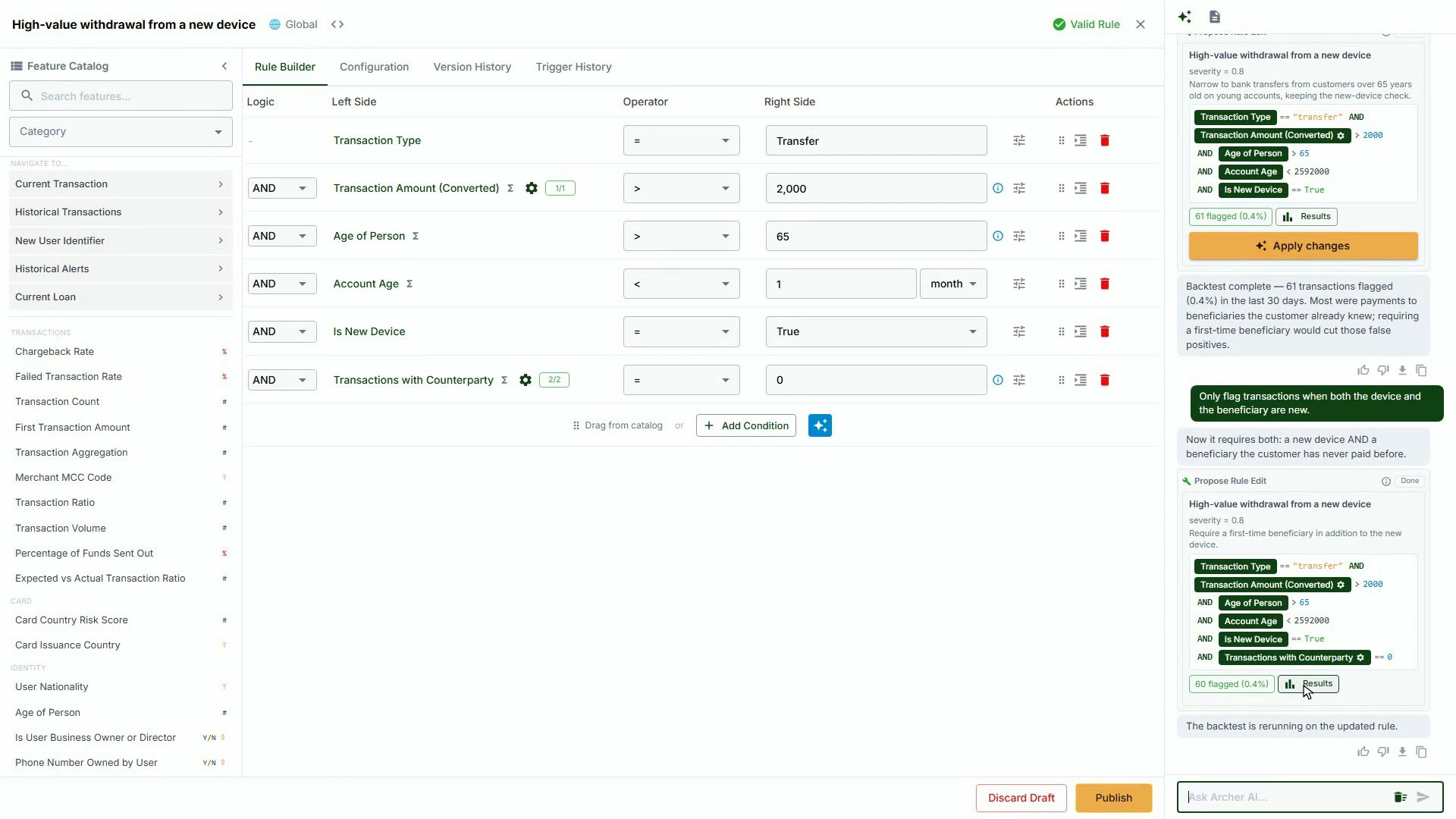
“Only flag transactions when both the device and the beneficiary are new.”
New rule, new backtest, a few seconds. Refining a rule stops being a change request and becomes a conversation, which means it happens as often as it should rather than as often as the roadmap allows.
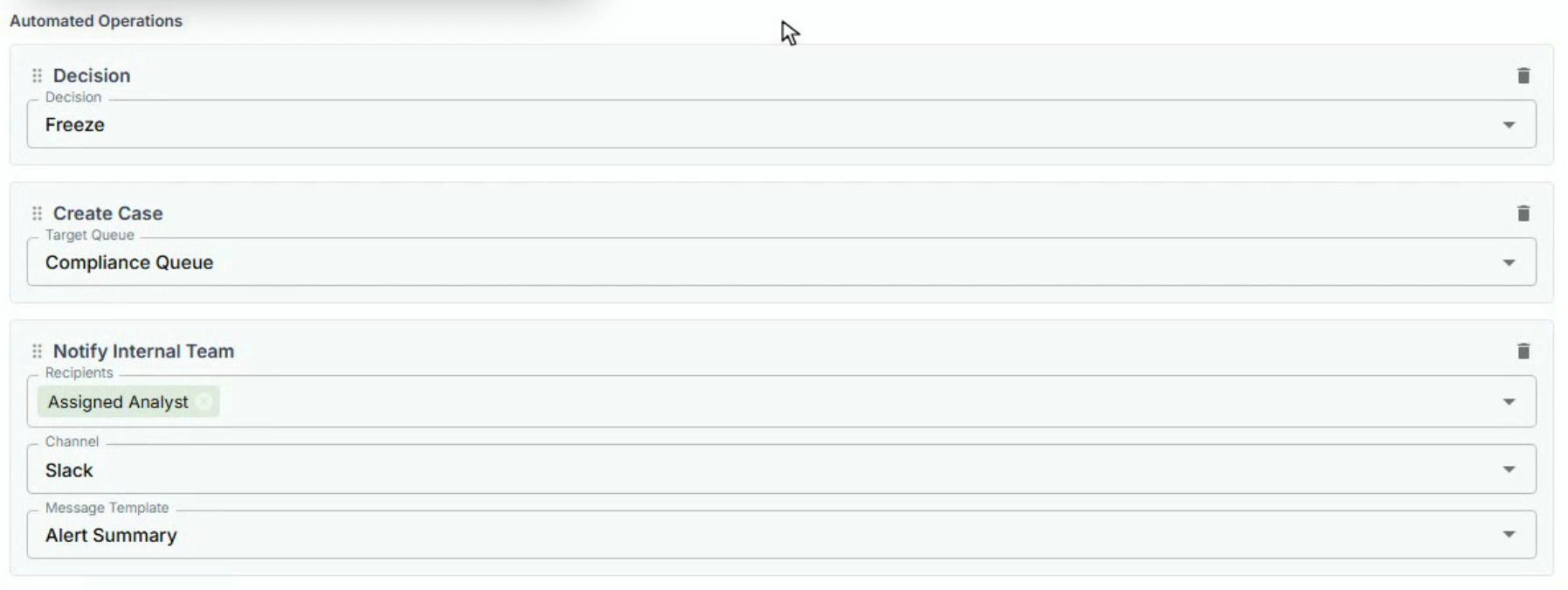
Then decide what the rule does when it fires: freeze the transaction, create a case in the compliance queue, and notify the assigned analyst in Slack.
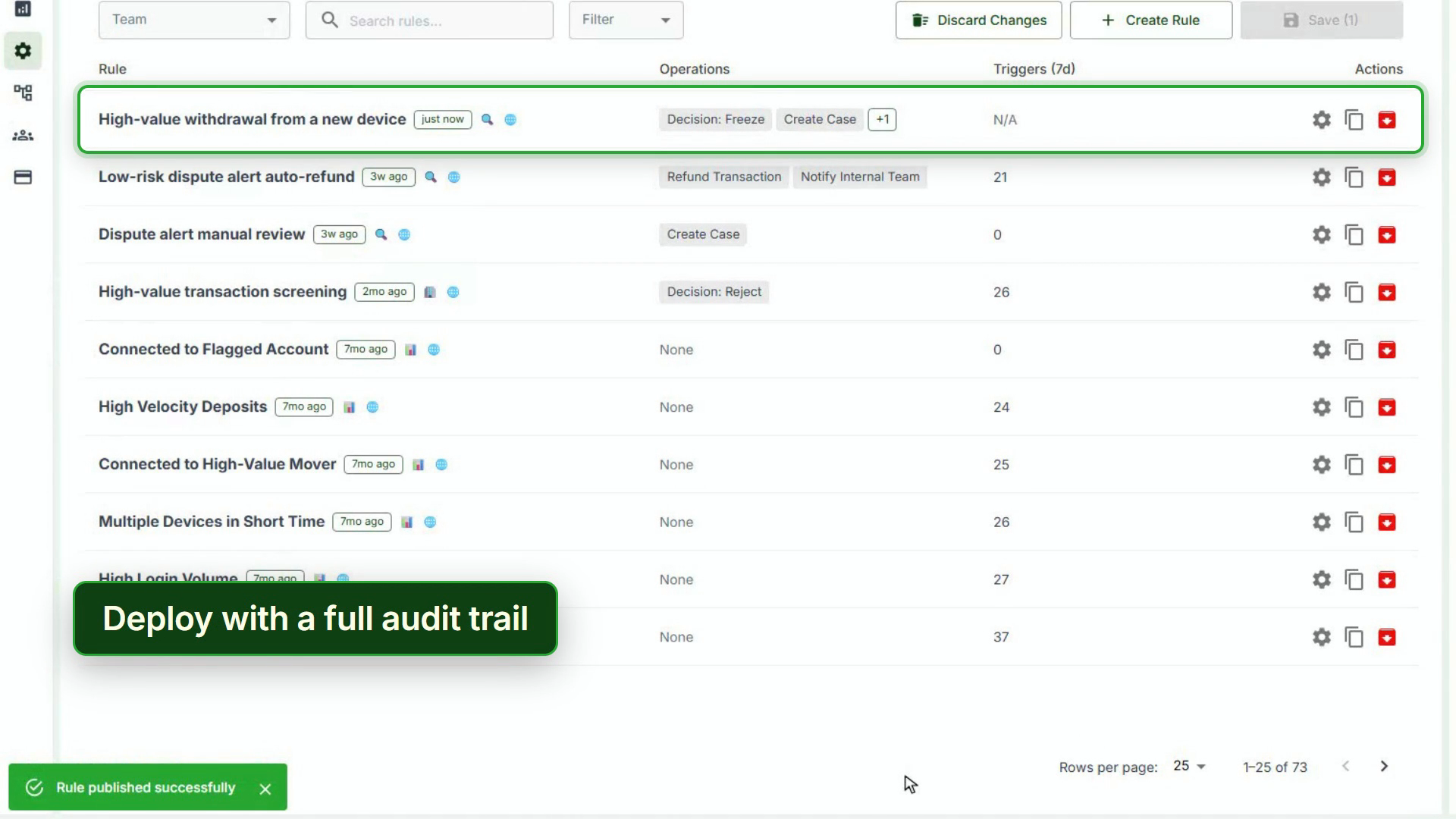
Push to production
One button. The rule is live against real traffic.
No deploy, no release window, no engineer on the other end of a ticket. The analyst who spotted the pattern is the person who shipped the control.
Five Seconds Instead of Four Weeks
On average an Archer customer builds or updates a rule in about five seconds. The same change through an engineering team is typically three to four weeks, assuming it wins its argument with the roadmap at all. Most rule optimisations are critical to the compliance team and invisible to everyone prioritising the sprint, which is exactly why they lose.
More precise rules help catch fraud without blocking legitimate customers.
Your engineers stop maintaining a rules backlog. Every fraud control your compliance team needs gets built in Archer instead of becoming a ticket, so compliance moves at the speed of the business and your engineering time goes back to the product you are actually selling.
Your rules go out of date faster than your roadmap can fix them. The teams that keep up are the ones where the person who spots the pattern is also the person who ships the rule, the same afternoon, without asking anyone’s permission.
That is what we built. If you want to see it against your own data, talk to us.